
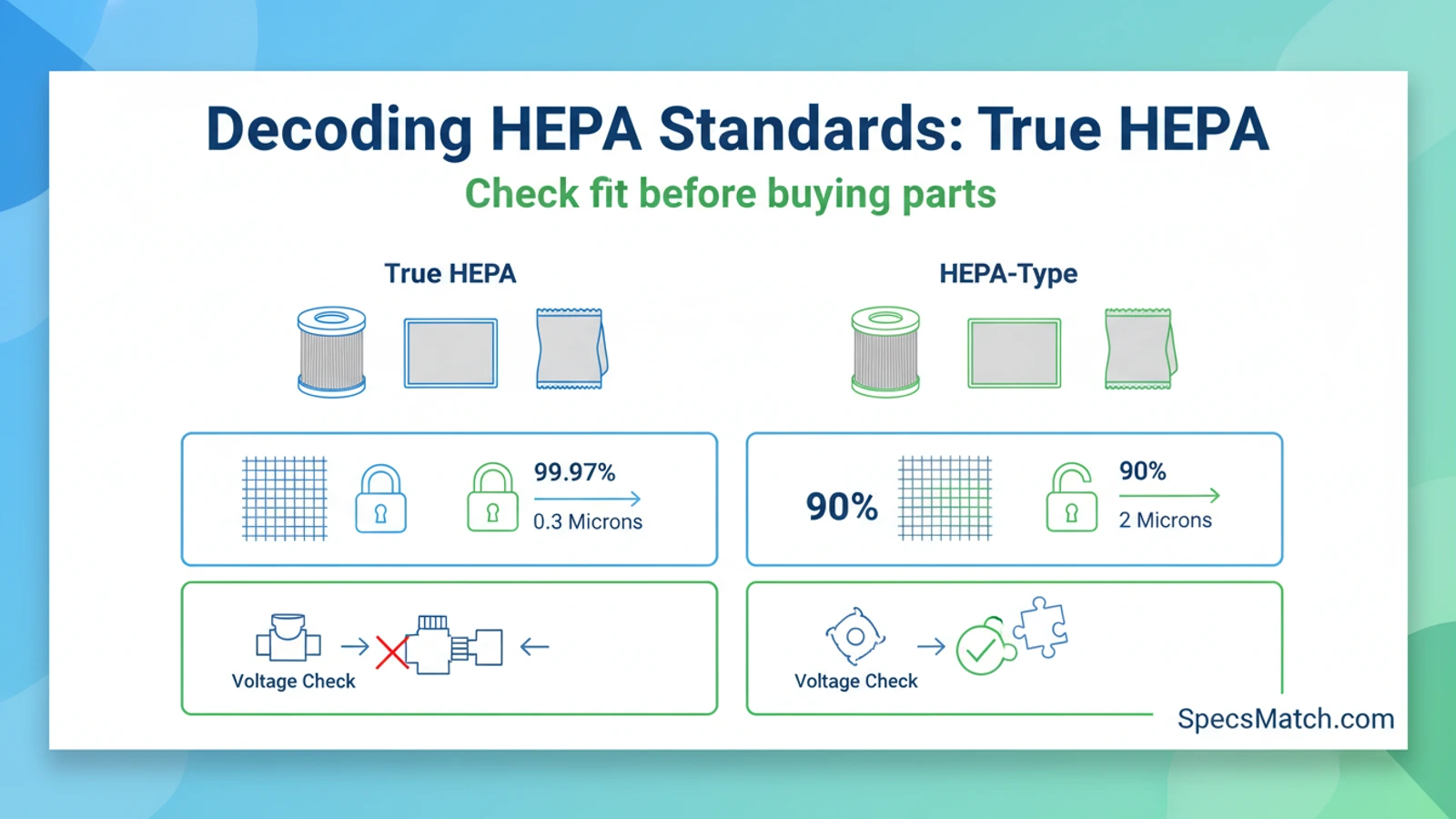
When shopping for replacement vacuum bags and filters, "HEPA" is one of the most heavily used terms on the packaging. However, the vacuum industry frequently uses variations of this acronym, leading to confusion. Understanding the distinct differences between "True HEPA" and "HEPA-Type" (or "HEPA-Like") is critical for managing household dust, pet dander, and allergens effectively.
Here is a breakdown of what these filtration standards actually mean and how to choose the right replacement parts for your specific vacuum model.
What is True HEPA?
"True HEPA" (High-Efficiency Particulate Air) is not just a marketing buzzword; it is a strict standard originally developed by the U.S. Department of Energy (DOE).
To qualify as True HEPA, a filter or vacuum bag must capture at least 99.97% of particles that are 0.3 microns in diameter.
* Why 0.3 microns? This specific size is considered the "Most Penetrating Particle Size" (MPPS). Particles of this size are the hardest to catch. If a filter can capture 99.97% of 0.3-micron particles, it is even more efficient at capturing particles that are larger *and* smaller than 0.3 microns.
* Best For: Households with asthma, severe allergies, pets, or those wanting the highest level of indoor air quality.
What is HEPA-Type (or HEPA-Like)?
"HEPA-Type," "HEPA-Like," or "HEPA-Style" are marketing terms used by manufacturers to describe filters that resemble HEPA filters but do not meet the strict 99.97% at 0.3 microns standard.
These filters are generally made of similar densely pleated synthetic materials but have a looser weave. A HEPA-Type filter might capture 99% of particles that are 2 microns or larger. While this is still a significant improvement over basic sponge or paper filters, it allows microscopic allergens, fine ash, and smoke particles to pass through and exhaust back into your room.
* Best For: General household cleaning, picking up visible dirt and hair, and budget-conscious shoppers who do not have severe respiratory sensitivities.
Key Differences at a Glance
* Filtration Efficiency: True HEPA captures 99.97% @ 0.3 microns. HEPA-Type usually captures 85% to 99% @ 1 to 2 microns.
* Airflow Restriction: True HEPA filters are incredibly dense, which restricts airflow. Vacuums must be specifically engineered with powerful motors and sealed systems to push air through them. HEPA-Type filters are less dense, allowing air to flow more freely.
* Cost: True HEPA filters and bags require advanced manufacturing and testing, making them more expensive. HEPA-Type replacements are generally more affordable.
The Importance of Exact-Model Matching
You cannot simply swap a standard or HEPA-Type filter for a True HEPA filter unless the vacuum manufacturer explicitly designed your machine to handle it.
Because True HEPA filters are so dense, putting one into a vacuum not engineered for it can severely restrict airflow. This can cause the vacuum to lose suction, overheat, and potentially damage the motor. Furthermore, if your vacuum does not have a "sealed system" (meaning air leaks out of the plastic housing before it even reaches the filter), paying extra for a True HEPA filter is a waste of money.
Always verify compatibility using your vacuum's exact model number. Never assume a filter or bag will fit or function properly just because it looks similar or shares a brand name.
To ensure you are buying the correct specification for your machine, use our dedicated compatibility tools:
* Check the Vacuum Filter Finder to locate the exact OEM or verified aftermarket filter for your model.
* Use the Vacuum Bag Finder to match your vacuum's model number to the correct bag code and filtration standard.
Frequently Asked Questions
Can I upgrade my standard vacuum to True HEPA?
You can only upgrade to True HEPA if the manufacturer provides an exact-model upgrade path for your specific vacuum. If the manufacturer does not list a True HEPA alternative for your exact model number, stick to the standard replacement to avoid overheating your motor.
Are HEPA-Type filters bad?
No. HEPA-Type filters are highly effective for standard household cleaning. They easily trap pet hair, dust bunnies, and larger debris. They are only insufficient if you specifically need medical-grade allergen removal.
How often should I replace my HEPA vacuum filter?
Always follow the manufacturer's guidelines for your exact model. Generally, pleated HEPA exhaust filters should be replaced every 6 to 12 months, depending on usage. If the filter is washable, ensure it is 100% air-dried before reinstalling, as moisture will destroy the HEPA material and ruin the vacuum motor.
Does a HEPA bag mean I don't need a HEPA filter?
Not necessarily. Many high-end vacuums use a multi-stage filtration system. A HEPA vacuum bag acts as the primary filter, trapping the vast majority of dust and allergens. A secondary HEPA exhaust filter catches any microscopic carbon dust from the motor or stray particles. Always replace both according to your model's specific maintenance schedule.
Finder links
Exact-model caveat
Always confirm the full model number and part code before ordering. A short product nickname, similar-looking part, or marketplace compatibility note is not enough by itself.
---
> SpecsMatch is not affiliated with any vacuum manufacturer mentioned in this guide.