
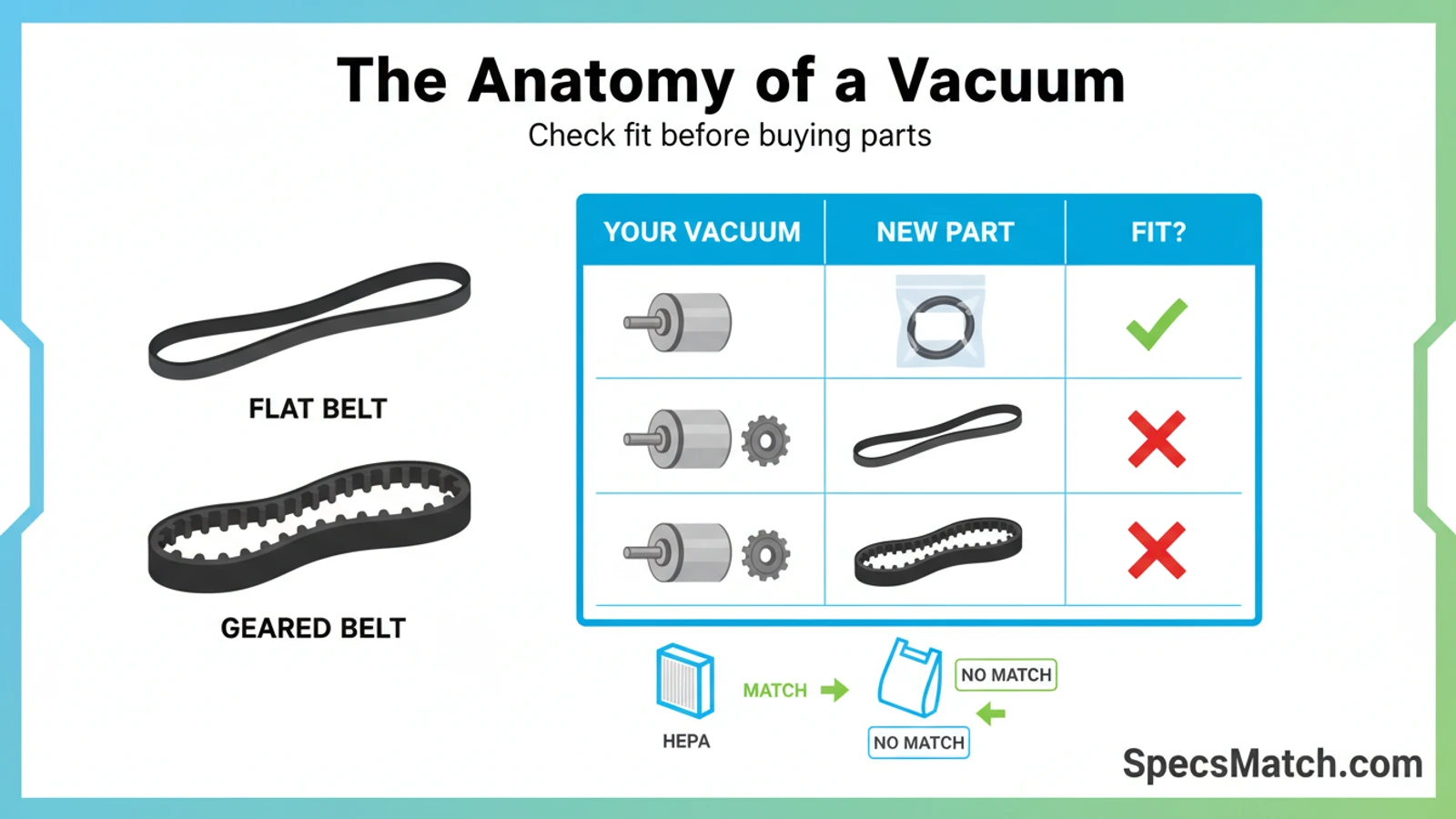
The drive belt is the unsung hero of your upright or canister vacuum cleaner. It serves as the critical link between the vacuum’s motor and the brush roll, translating electrical power into the physical sweeping action that pulls embedded dirt from your carpets. However, not all belts are created equal.
The two most common styles—flat belts and geared belts—operate on entirely different mechanical principles. Understanding the anatomy of these belts is crucial for maintaining your vacuum's performance. When it comes time for maintenance, remember: you must always verify your exact vacuum model number before purchasing a replacement to ensure a proper fit.
Flat Vacuum Belts: The Traditional Standard
Flat belts are the most common type of vacuum belt, especially in budget-friendly and traditional upright models.
How They Work:
Flat belts are smooth, continuous loops typically made of solid rubber. They rely entirely on physical tension and friction to grip the smooth metal motor shaft and the brush roll.
The Advantages:
The primary benefit of a flat belt is its ability to slip. If you accidentally vacuum up a sock or the brush roll gets jammed with heavy carpet fringe, the flat belt will slip against the motor shaft instead of forcing the motor to a sudden, damaging halt. This slipping action acts as a mechanical fail-safe to protect the vacuum's motor.
The Disadvantages:
Because they rely on tension, flat belts stretch out over time. Even if the belt doesn't break, a stretched belt will lose its grip, causing the brush roll to slow down or stop spinning entirely when it touches the carpet. For optimal performance, flat belts usually require replacement every 6 to 12 months.
Geared Vacuum Belts: Precision and Power
Geared belts, also known as cogged or toothed belts, are typically found in higher-end vacuums, commercial units, and models with dedicated brush roll motors.
How They Work:
Unlike smooth flat belts, geared belts feature horizontal teeth along the inside loop. These teeth interlock perfectly with matching gears on both the motor shaft and the brush roll, operating much like a timing belt in a car engine.
The Advantages:
Geared belts provide a direct, slip-free transfer of power. Because they do not rely on tension and friction, they do not stretch out over time. A geared belt will often last the entire lifetime of the vacuum cleaner, provided it isn't subjected to severe physical trauma.
The Disadvantages:
Because a geared belt cannot slip, a jammed brush roll transfers the stoppage directly to the motor. To prevent the motor from burning out, vacuums with geared belts must be equipped with an electronic brush roll shut-off or a mechanical clutch.
Can You Interchange Geared and Flat Belts?
No. Flat and geared belts are completely incompatible with one another.
The pulleys and motor shafts on your vacuum are engineered specifically for one type of belt. A flat belt will not grip a geared pulley, and a geared belt cannot sit flush on a smooth friction pulley.
The Exact-Model Caveat: Never guess your belt type based on visual similarity or rough measurements. Belts that look identical to the naked eye may have slightly different circumferences, thicknesses, or tooth pitches. Always locate your vacuum's exact model number (usually found on a data plate on the back or bottom of the unit) to ensure you are purchasing the correct replacement part.
Signs It Is Time for a Replacement
If your vacuum is losing its cleaning power, the belt is often the culprit. Look for these common signs:
* Loss of Agitation: The vacuum sucks up surface debris but leaves embedded pet hair and dirt behind. If the brush roll stops spinning when it touches the carpet, a flat belt has likely stretched out.
* Burning Rubber Smell: This is a classic sign of a flat belt slipping against the motor shaft due to a jam or loss of tension.
* Visible Wear: Deep cracks, fraying edges, or sheared-off teeth (on geared belts) mean immediate replacement is necessary.
Complete Your Vacuum Maintenance
Replacing a worn drive belt is one of the most effective ways to restore your vacuum
Finder links
Exact-model caveat
Always confirm the full model number and part code before ordering. A short product nickname, similar-looking part, or marketplace compatibility note is not enough by itself.
---
> SpecsMatch is not affiliated with any vacuum manufacturer mentioned in this guide.